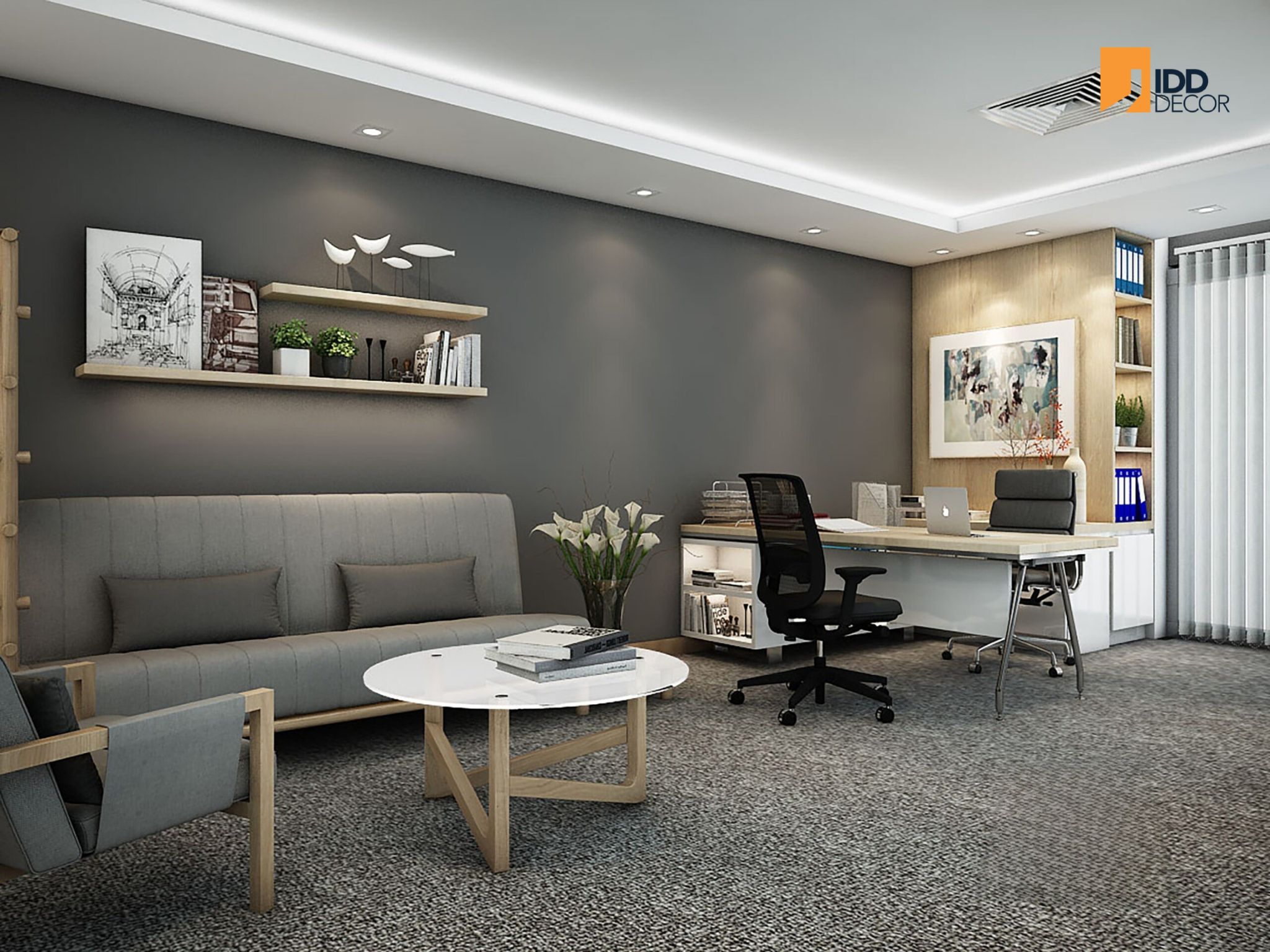


In today’s modern corporate environment—where the speed of decision-making directly impacts competitive advantage—the director’s office is no longer merely a personal workspace. Contemporary director’s office interior design is increasingly regarded as a strategic management tool that helps optimize time, enhance executive performance, and reflect modern leadership thinking. This article analyzes how the concept of a “time-optimized design language” is applied in high-end director offices, while outlining key design principles suitable for international enterprises operating in Vietnam.
In office interior design, a “time-optimized design language” does not refer to a specific aesthetic style. Instead, it is an approach to spatial organization based on actual usage efficiency. This design philosophy focuses on three fundamental questions:
What activities does the user need to perform in this space?
In what sequence do these activities occur?
How can the time between these activities be reduced without compromising decision quality?
For a director’s office, this space accommodates multiple critical functions, including focused individual work, meetings with senior partners, quick internal discussions, confidential document handling, and strategic decision-making. Every interior design detail must therefore support time efficiency while maintaining a high level of concentration.
Unlike employee workspaces, the director’s office is where decisions have organization-wide implications. Inefficient layouts can unnecessarily prolong thinking, communication, and approval processes. In many office interior design projects implemented by IDD Decor, restructuring the director’s office has significantly reduced daily task-processing time.
In corporate governance, a director’s time is a scarce resource. Minutes lost due to unnecessary movement, document searches, or visual distractions represent indirect operational costs. Time-optimized director office interior design minimizes these “invisible costs” through strategic layout planning, furniture selection, and integrated technology.
For multinational corporations, the director’s office also serves as a reception space for partners, auditors, and regional leadership. A well-designed, efficient, and thoughtfully planned environment clearly communicates a professional and globally aligned management style.
Rather than relying on intuition, the director’s office should be planned around the executive’s actual behavioral sequence:
Focused individual work
Quick exchanges with assistants or middle management
Meetings with partners and guests
Document approval and storage
Each area should be arranged in a continuous flow, minimizing the need to stand up, relocate, or shift between spaces.
An effective director’s office typically includes:
The primary executive desk area
A small meeting area (2–4 people)
A formal guest reception area
Storage and display areas
Clear zoning allows the director to transition quickly between work modes without disrupting cognitive continuity.
 |
4.1. The Executive Desk as the Decision-Making HubIn director’s office interior design, the desk is more than a piece of furniture—it is an operational command center. Executive desks are often designed to include:
This reduces preparation time and supports seamless workflow continuity. 4.2. Storage Systems and Back Walls: Accessibility and Brand IdentityThe wall behind the executive desk often integrates storage cabinets, display shelves, or brand identity elements. This approach enables quick access to documents, provides visual support for the leader, and reinforces corporate identity during meetings with guests. |
5.1. Natural Light and Sustained ConcentrationNumerous studies indicate that natural light enhances focus and reduces fatigue. In high-end office interior design projects, IDD Decor prioritizes maximizing natural light in director’s offices through glass partitions and flexible shading systems. See more: The executive office interior design of IDP Education Hai Ba Trung |
|
 |
Director’s office lighting is typically designed in layers, including ambient lighting, task lighting at the desk, and accent lighting in guest areas. This allows executives to transition quickly between activities without complex adjustments.
|
6.1. Colors That Stabilize Executive PsychologyNeutral and warm tones such as wood brown, gray, beige, and deep blue are commonly used in director’s office interior design. These colors help reduce stress, enhance concentration, and create a sense of stability and trust. |
High-quality materials reduce maintenance and repair time—an often-overlooked factor that has long-term implications for space efficiency and operational continuity.
A modern director’s office typically integrates online meeting systems, concealed presentation screens, and smart controls for lighting, curtains, and air conditioning. Incorporating these systems during the interior design phase ensures the space is always ready for any work scenario and minimizes future renovations.
IDD Decor approaches director’s offices as strategic workspaces rather than purely aesthetic environments. Each design is based on executive behavior analysis, alignment with corporate culture, and compliance with international office standards. The ultimate objective is to optimize time, improve decision quality, and establish a clear leadership presence.
As corporate operations continue to accelerate, director’s office interior design based on time-optimized design language has become a critical factor in sustainable executive performance. A well-designed office not only saves time but also elevates management thinking and strengthens corporate image in the eyes of partners.
IDD Decor – Office Interior Design
Behind every door lies the path to success.
Address: Doxaco Building, 307B Nguyen Van Troi Street, Tan Son Hoa Ward (formerly Ward 1, Tan Binh District), Ho Chi Minh City
Hotline: 0896 640 986
Website: idddecor.com
LinkedIn: https://www.linkedin.com/company/idddecorvn/