

Internal communication is one of the key elements that shape corporate culture, strengthen connections between individuals, and lay the foundation for creativity and innovation. In an era of flexible work models and diverse operations, effective internal communication not only ensures smooth workflows but also helps retain talent and foster collective strength. So, how does office interior design influence internal communication? IDD Decor’s insights below will shed light on this question.
Communication is how a company shares its mission, vision, and core values with employees. It serves as a bridge between management and execution teams.
A workspace that encourages communication helps corporate values spread naturally and become internalized in every individual. According to a McKinsey & Company (2023) report, organizations with effective internal communication strategies perform 20–25% better than their industry average (Source: McKinsey “The Organization Blog”).
When employees feel they can easily interact, exchange ideas, and share perspectives, they develop a stronger sense of belonging. Good communication reduces misunderstandings, builds trust, and creates a positive working environment.
One of the most common strategies today is open-space design, which encourages accessibility and interaction instead of isolating employees behind traditional partitions.
 |
Open discussion area – CMA CGM Vietnam Office Design by IDD Decor The open discussion area of the CMA CGM Vietnam project avoids excessive compartmentalization, using flexible seating and mobile whiteboards. This enables teams to form and collaborate dynamically based on project needs. |
Creating Multiple Communication Touchpoints
Beyond workstations, “communication touchpoints” such as pantries or connecting corridors play a crucial role. Thoughtful spatial planning in these areas increases spontaneous encounters — a key ingredient in creative idea generation.
| At Publicis Group Vietnam, IDD Decor designed a pantry that blends relaxation and interaction zones, helping employees unwind while encouraging open conversation. |  |
Collaborative areas accelerate decision-making and enhance teamwork efficiency. These spaces should feature round tables, sofas, soft benches, or foldable/movable tables, along with whiteboards and video conferencing setups to accommodate various working needs.
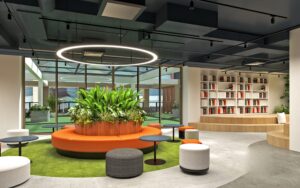 |
IDP Hai Bà Trưng Campus Office Design – Subtle Integration of Greenery In this project, discussion zones were placed adjacent to work areas, allowing easy exchanges while maintaining necessary privacy. |
To design spaces that promote communication, the design firm must understand the company’s structure, interdepartmental needs, and communication habits. Data collection through surveys, interviews, or workflow modeling forms the foundation for optimal layout planning.
Every organization has its own identity and structure — there’s no one-size-fits-all formula. For instance, creative agencies like Publicis require open, flexible, and artistic spaces; while engineering firms like Ecoba need order and vertical collaboration without compromising teamwork.
Natural light, soft furnishings, warm materials, and connective colors influence how employees feel and engage with each other. Details such as focused lighting in discussion zones, friendly seating textures, and semi-open ceilings for better sound resonance all contribute to a communication-friendly atmosphere.
A Harvard Business Review (2022) study found that companies with effective internal communication retain 47% more employees and achieve 21% higher team productivity (Source: HBR – “How to Build a Culture of Effective Communication”).
As organizations transition to hybrid or AI-assisted models, flexible communication helps maintain cohesion. A well-designed communication-focused workspace becomes an anchor — preserving corporate identity while enabling adaptation to technology.
Casual pantry conversations, spontaneous brainstorming sessions, and informal sharing spaces allow knowledge to circulate organically — something structured knowledge systems can’t always achieve.
Audit internal communication flows: Conduct surveys to identify spatial bottlenecks.
Invest in diverse communication zones: Beyond meeting rooms — include pantries, libraries, multipurpose areas, and corridors.
Align design with culture: Let the space express corporate values through materials, colors, lighting, and layout.
Choose a professional design-build partner: Collaborating with firms like IDD Decor, experienced in multiple industries and international standards, helps maximize investment efficiency and avoid spatial design pitfalls.
Designing a workspace that enhances internal communication is not merely an aesthetic choice — it is a long-term investment strategy for corporate culture. In a dynamic world where people work not just for tasks but for connection and inspiration, the office becomes the bridge linking values and performance.
Office design and construction are no longer just about interiors — they are about building a foundation for communication, culture, creativity, and growth.
IDD Decor – Office Interior Design – Behind the Door Awaits the Journey to Success.
📍 Address: Doxaco Building, 307B Nguyen Van Troi, Tan Son Hoa Ward (formerly Ward 1, Tan Binh District), Ho Chi Minh City
📞 Hotline: 0896 640 986
🌐 Website: idddecor.com
🔗 LinkedIn: IDD Decor Vietnam