


Green plants in office design are not merely decorative. According to modern Feng Shui, they represent the Wood element (Mộc) — nurturing, growth, and atmospheric balance. When businesses set Environmental (E) and Social (S) goals within ESG, greenery becomes a strategic element: it supports a healthy workspace, enhances human connection, and reduces energy consumption.
According to sources such as the NASA Clean Air Study, certain plants can absorb VOCs (like formaldehyde, benzene). However, recent studies emphasize that in standard office environments, the air-cleaning effect is limited — a significant number of plants would be required for measurable results.
Even so, plants increase humidity, reduce dust and microfungi, and improve the overall workplace atmosphere, contributing to the E criteria of environmental well-being.
Studies published in the Journal of Environmental Research and Public Health show that indoor greenery helps stabilize humidity, reduce fatigue, headaches, coughing, and eye irritation — ultimately lowering sick leave rates. Workplaces with plants experience better air comfort, fewer sick days, and a higher quality of life.
Following the biophilic design principle, plants help regulate temperature, lower surrounding surface heat, and reduce the need for cooling energy — aligning with E goals of resource efficiency and environmental performance.
Studies from Wellable, Wired, and Time.com confirm that green environments can boost productivity by up to 15%, improving focus, work satisfaction, and creativity.
According to Time.com and Self, plants lower cortisol — the stress hormone — enhancing relaxation, happiness, and self-esteem.
Shared green spaces encourage natural interactions and team bonding, spreading positive community energy — a reflection of S values: well-being and a supportive corporate culture.
In modern Feng Shui, plants embody the Wood element (Mộc) — freshness, vitality, and growth.
Some key principles include:
Choose healthy plants with soft, rounded leaves — avoid thorny or sharp-edged varieties to prevent “conflicting energy.”
Avoid wilted or dying plants — they may generate negative energy.
Place plants in energy-enhancing directions, such as East or Southeast, to attract creativity, prosperity, and growth (according to the Bagua map for Wood).
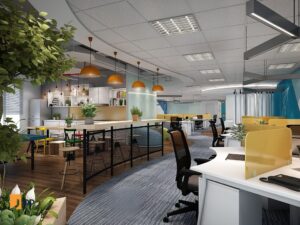 |
Traveloka Office – Ho Chi Minh CityIDD Decor used indoor plants and glass partitions in work and pantry areas to reduce surface heat, enhance microclimate (E), and inspire a youthful, creative atmosphere for employees (S). |
|
|
|
||
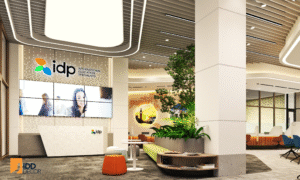
IDP Education Hai Bà TrưngAt the reception, a small central garden with friendly plants provides natural air, reduces stress, and creates a welcoming waiting space for parents and students — expressing care and connection (E & S). |
|
|
|
|
||

|
ECOBA Office – HanoiGreenery was strategically placed at open communication corners near large glass windows.
|
5. Steps to Effectively Implement Greenery Under ESG
Step 1: Assess the current space and indoor climate.
Identify areas with poor light or air quality that need improvement.
Step 2: Select suitable plant species.
Choose easy-care plants like Sansevieria (snake plant), Pothos, Dracaena, or Aglaonema — Feng Shui-friendly and sustainable (source: Planterra).
Step 3: Align placement with Feng Shui and the Five Elements.
For instance, place plants in the Southeast for Wood energy — stimulating creativity and prosperity — and near windows for natural light.
Step 4: Combine greenery with suitable lighting.
Use natural light where possible; in dim areas, LED lighting supports plant growth while saving energy.
Step 5: Schedule plant care and assign team responsibility.
Encouraging employees to participate in plant maintenance fosters teamwork and strengthens the S pillar of care and community.
Green plants are an essential link between E (Environmental) and S (Social) pillars in ESG, aligning with the Wood element of Feng Shui.
They create a dynamic, healthy workspace, enhance productivity, and embody corporate commitment to human-centered, sustainable growth.
With real-world experience from projects like Traveloka, ECOBA, and IDP Hai Bà Trưng, IDD Decor provides tailored greenery solutions that balance Feng Shui and ESG goals — helping companies elevate workplace well-being and sustainability.
IDD Decor – Office Interior Design – Behind every door lies the path to success.
📍 Doxaco Building, 307B Nguyễn Văn Trỗi, Tân Sơn Hòa Ward (Former Ward 1, Tân Bình District), Ho Chi Minh City
📞 Hotline: 0896 640 986
🌐 Website: idddecor.com
🔗 LinkedIn: linkedin.com/company/idddecorvn